
Vacation rentals are not new.
Long before apps, algorithms and global online marketplaces, Canadian families rented cottages, cabins, ski chalets and seaside homes. They found them through tourism offices, newspaper advertisements, rental managers, referrals and, eventually, the owners’ own websites.
Travellers contacted the owner or property manager directly. They asked questions, made arrangements and paid the Canadian business providing the accommodation.
What changed was not the vacation rental. What changed was who controlled the front door.
From Online Directory to Booking Intermediary
VRBO traces its beginnings to 1995, when it introduced an online way for homeowners to connect with families looking for vacation rentals.
In those early years, the model was much closer to a classified directory. Owners paid to advertise their properties, travellers found them, and the relationship continued directly between the two parties.
HomeAway acquired VRBO in 2006 as part of a broader strategy to assemble vacation-rental listing websites around the world.
Airbnb arrived more than a decade later. It began in 2007 and officially launched as Airbed & Breakfast in 2008. Within months, it had introduced its own payment platform. By 2009, it had shortened its name to Airbnb and expanded from rooms into apartments, entire homes and traditional vacation rentals.
These companies solved a genuine problem. Travellers could suddenly search thousands of properties in one place. Hosts could reach people far beyond their local communities. Reviews, online payments, professional photography, search filters and instant booking made vacation rentals feel easier and more trustworthy.
Convenience won.
And then, almost without us noticing, discovery became dependency.
The Moment the Model Changed
The most consequential shift occurred during the mid-2010s.
In November 2015, Expedia announced that it would acquire HomeAway and its brands, including VRBO, for approximately US$3.9 billion. Expedia described its goal plainly: to accelerate HomeAway’s shift from a classified marketplace to an online transactional model.
The acquisition was completed in December 2015.
At approximately the same time, HomeAway announced that it would introduce a new traveller service fee in 2016. The company expected the fee to add an average of roughly 6% to transactions processed through its online shopping cart.
That was an important dividing line.
A directory helps travellers discover a business. A transactional platform stands between the traveller and that business. It manages the checkout, processes the money, controls parts of the communication and collects a fee from one or both sides of the reservation.
The platform was no longer simply showing travellers where they could stay. It was becoming the place where the booking itself was expected to happen.
Canada Adopted the Model Remarkably Quickly
The change in Canadian booking behaviour was dramatic.
Statistics Canada found that reservation days booked through the country’s largest private-accommodation platform grew from approximately 1.7 million in 2015 to nearly 10 million in 2017.
That was growth of 485% in only two years.
By 2021, private short-term rentals represented an estimated 15.2% of total Canadian accommodation-sector revenue, up from 7% in 2017. In British Columbia, their share had reached 20%.
This did not happen through some dark conspiracy. It happened in full view, one convenient booking at a time.
Travellers became accustomed to starting their search on the same few websites. Hosts learned that visibility depended on appearing inside those marketplaces. Reviews accumulated on the platforms rather than with the individual accommodation business.
Repeat guests often returned to the platform instead of returning directly to the host. The website that once helped people discover the accommodation gradually became more recognizable than the accommodation provider itself.
What Do the Fees Look Like on a Real Property?
It is easy to talk about platform fees in the abstract.
A company might advertise a host fee of a few percentage points. A traveller might see a service fee at checkout. Another fee may be incorporated into the nightly price rather than presented separately.
What is harder to see is the combined cost surrounding the same reservation.
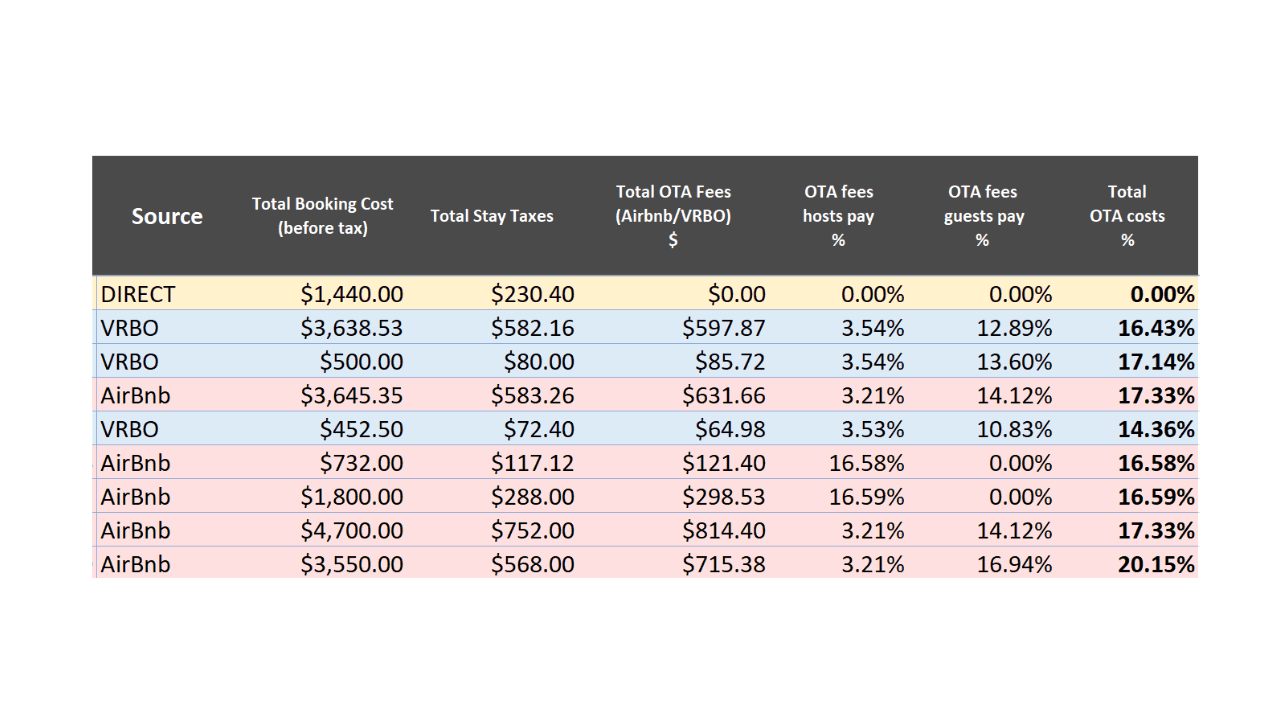
To understand what this can look like in practice, StayCanadian reviewed reservation records from one independently operated Canadian vacation rental through 2025 and early 2026. The total real-world numbers were startling.
Across the reservations we reviewed, combined host and guest platform fees average 16.73% of the pre-tax accommodation charges.
Across the Airbnb reservations reviewed, combined fees averaged 17.31% of the accommodation value. Across the Vrbo reservations reviewed, combined fees averaged 15.80%. Some individual reservations were substantially higher.
On one Airbnb reservation, the combined host and guest platform fees were equal to 20.15% of the total accommodation price. One Vrbo reservation reached 19.93%.
That’s nearly one-fifth of the accommodation value.
The Fee Itself is also Taxed
The now commonly quoted 15% platform fee does not tell the whole story.
Canadian tax rules generally treat booking, administration and similar fees charged in connection with short-term accommodation as taxable services. Depending on the jurisdiction and fee structure, GST, HST or QST may be applied to platform service fees.
Both Airbnb and Vrbo indicate that applicable Canadian taxes may be collected on their service fees.
In the property records reviewed for this article, GST was included in certain host platform fees where applicable. This means the cost is not always limited to the percentage described as the platform’s fee. Tax may also be charged on the service of charging the fee.
A platform fee is added to the accommodation, and then tax can be added to the platform fee. Meanwhile, the traveller is also paying the ordinary taxes associated with the stay itself.
What Does “Leaving Canada” Really Mean?
This distinction matters.
It would not be accurate to say that every dollar included in the 16.73% average leaves Canada.
GST and other applicable Canadian taxes are remitted within the Canadian tax system. Those amounts should not be described as foreign corporate revenue.
The commercial portion of the platform fee is different. That portion becomes revenue for a foreign-owned technology intermediary rather than remaining with the Canadian accommodation provider or in the traveller’s pocket.
That is the real economic concern.
When we say that a platform can add 15%, 17% or even close to 20% to the economics surrounding a Canadian vacation-rental reservation, we are describing the combined platform costs.
Part of that amount may be tax. A significant commercial portion is collected by the company controlling the transaction.
The traveller pays more. The host receives less. And that money is no longer available to circulate in our economy.
What Could That Money Do Instead?
On a $2,000 accommodation purchase, a platform cost of 16.73% represents approximately $335. At 20%, it represents $400.
That could help a family stay another night. It could pay for dinner at a local restaurant, groceries from a neighbourhood market, admission to an attraction, a guided excursion or fuel for the journey home.
Booking more nights means the Canadian host earns more, helping them employ local cleaners, tradespeople, photographers, landscapers, maintenance workers and property managers.
Lower accommodation costs can make a trip possible for a family that is reconsidering whether they can afford to travel at all. They can allow visitors to stay longer, travel more often and spend more once they arrive.
It is a connected economic loop.
Lower booking costs make Canadian travel more affordable. Greater affordability can lead to more bookings and longer stays. More bookings improve host occupancy and revenue. More visitor spending strengthens the local businesses and communities that make the destination worth visiting.
The Platforms Did Create Value
It is important to be fair about how we arrived here.
The large online travel platforms did not grow by offering nothing. They built recognizable brands. They invested in technology, advertising, payment processing, reviews, customer support and trust systems. They taught millions of people that booking a stranger’s home online could feel normal and safe.
They made vacation rentals easier to find.
And over time, the tool became the tollbooth.
Travellers began to believe that the safest way to book was through the intermediary. Hosts became dependent on the intermediary for visibility. The platform gained control of the audience, the transaction and the relationship.
The business providing the actual accommodation became a supplier inside someone else’s marketplace.
We Can Build a Better Front Door
The answer is not to reject technology or return travellers to newspaper advertisements and endless internet searches.
The answer is to use technology differently.
Travellers still need one trusted place where they can search Canadian vacation rentals, compare destinations, view availability and discover legitimate hosts.
They do not necessarily need another company inserting itself into the payment, charging a percentage of the stay and controlling the relationship after the introduction has been made.
A discovery platform can help travellers find verified Canadian accommodations and then guide them directly to the host’s own booking website.
The host remains responsible for the property, pricing, policies, payment and guest relationship. The traveller gains a more transparent path to booking. And more of the value created by the trip stays with the people and communities delivering the experience.
That is why we built StayCanadian.
For years, we have been taught that the platform is the destination.
It is not.
Canada is the destination.
A Note About the Reservation Analysis
The fee percentages in this article are based on an anonymized review of 63 Airbnb and Vrbo reservations from independently operated Canadian vacation rentals. They are presented as a case study, not as a claim about every property, host agreement or traveller reservation.
The percentages compare combined host and guest platform fees with the accommodation cost and applicable taxes recorded for each reservation.